
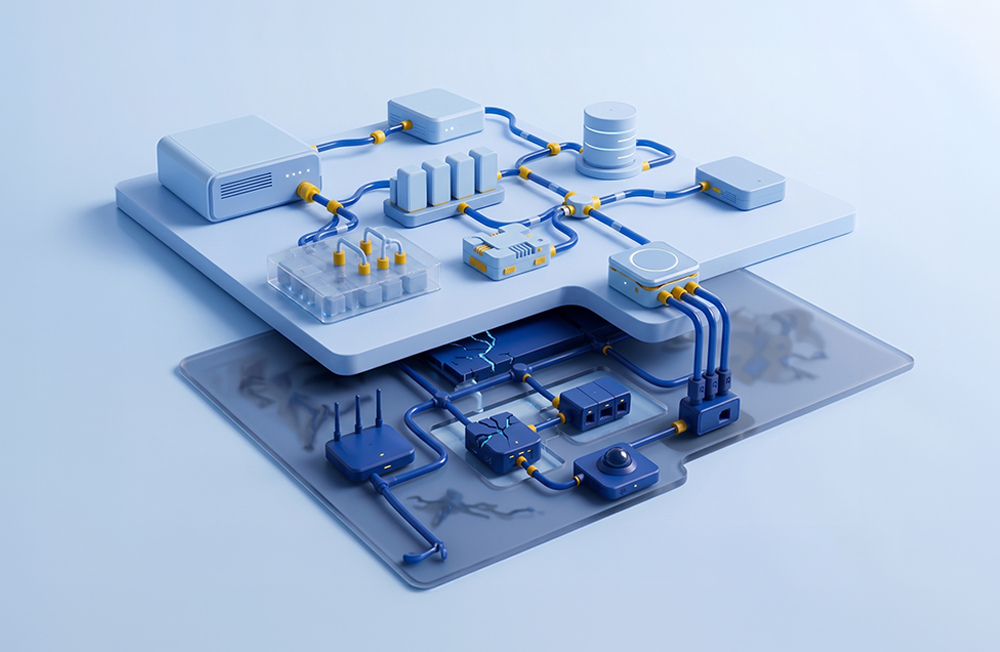
Most reconnaissance engagements start the same way. Nmap sweeps the known segments, arp-scan catches what the sweep missed, and Kismet maps the wireless side. Then Wireshark reads the wire. But each tool exports its own format. None share a common key. Correlation happens by hand after the fact, and that is where findings disappear. The host arp-scan sees at layer 2 what Nmap never returns.
This article walks through the methodology, the toolset that holds up, where these tools stop delivering, and what agentic recon changes.
Network reconnaissance is the systematic discovery of hosts, services, devices, and network relationships to produce an asset map and an attack surface profile before any further engagement work begins. It leads every red team operation, penetration test, and threat hunting program, because everything downstream is a decision made against that map.
Completeness is the limiting factor. A pass that enumerates only the managed environment has described the organization's own inventory back to it, and an attacker works outside that inventory. Coverage has to reach the assets nobody registered or pointed a collector at, which is the standard every discussion of network reconnaissance tools in this guide gets measured against.
The distinction is about whether you touch the target, and it sets your detection risk for the whole engagement.
The sequencing survives the shift to agent-driven work, because the constraint is the engagement rules rather than the tooling. Scope discipline is what makes network reconnaissance tools safe to run against a live environment, and it stays the operator's call regardless of what executes the collection.
The tools below recur across engagement writeups and practitioner discussion. Each of these network reconnaissance tools is genuinely good at its job, and each job is defined narrowly.
| Tool | Best for | What it misses | Detection profile |
|---|---|---|---|
| Nmap | Host and service discovery on a known network segment | Unmanaged devices, segmented hosts, and off-network assets | Active, noisy at default timing |
| Shodan | Internet-facing asset and service discovery at scale | Internal-only, segmented, and air-gapped assets | Passive from the target's view |
| Censys | Internet-wide host and certificate inventory | The same internal blind spot as Shodan | Passive from the target's view |
| Wireshark | Protocol-level analysis of live traffic | Anything outside the capture point's traffic path | Passive, requires an existing position |
| Maltego | OSINT and entity relationship mapping | Relationships with no public data trail | Passive |
| Recon-NG | Web-based enumeration, subdomains, and public records | Non-web infrastructure and unpublished assets | Mostly passive |
| BloodHound | Active Directory relationships and privilege escalation paths | Non-domain assets and general network discovery | Requires domain visibility |
Read the third column as a set and the problem's shape appears. Strike48 treats that pattern as the starting condition, since a toolkit assembled from narrow scopes inherits every gap between them.
Every tool in that table operates from outside the target environment or from a network segment somebody already decided to scan. A scan reaches the hosts it can route to, a capture sees the traffic crossing its interface, and a log-based detection fires on events that reached a collector. An asset that satisfies none of those conditions never appears at all.
Three asset classes sit outside all of those conditions at once, and that is where traditional network reconnaissance tools reach their limit.
| Asset class | How it gets there | Why remote tooling misses it |
|---|---|---|
| Unmanaged endpoint | A contractor's laptop joins corporate WiFi without registering to Active Directory | No directory object, no agent, and no route from the scanning host |
| Rogue access point | Someone plugs a consumer AP into a conference room port because the signal is weak | No wireless management console knows the SSID exists |
| Unmonitored appliance | A building-management controller sits on a VLAN with no logging agent | Admin interface reachable only from that segment, zero telemetry to a collector |
A 2025 Trend Micro survey of more than 2,000 security executives, reported by CSO Online, found nearly 73% of security leaders had experienced incidents caused by unknown or unmanaged assets. Lansweeper, citing the Verizon 2025 Data Breach Investigations Report, puts 46% of compromised devices with corporate logins on non-managed systems. Those two numbers describe one problem from two directions. Assets outside inventory are both the least examined and the most frequently compromised, and unmanaged IoT deployments keep widening the category faster than inventory absorbs it.
Strike48's 2026 survey of 100 security leaders quantifies the gap from the defender side. 84% report their current tools cannot access all their log data for investigations, and 65% have had an investigation stall because data was trapped in a system their tools could not reach. An asset that generates no telemetry and a data store the investigation layer cannot query produces the same outcome: an environment defenders believe they have mapped but have not.
CrowdStrike's 2026 Global Threat Report puts average eCrime breakout time at 29 minutes, down from 48 the year before, with the fastest observed intrusion moving in 27 seconds. When a foothold becomes lateral movement that fast, a detection model that depends on an asset having registered itself is already running behind the intrusion.
Remote scanning and log-based detection consistently miss three categories. Unmanaged devices never register to central management, rogue access points sit outside sanctioned wireless infrastructure, and SIEM-invisible hosts run activity that never reaches a collector. All three share one property. Finding them requires being on the same network segment they are on. That is the boundary no remote scanner crosses, and it is why network reconnaissance tools built for outside-in visibility cannot close it.
Fragmentation adds a second cost on top of the visibility ceiling. Four tools produce four output formats on four timelines, and the correlation happens in an analyst's head or a spreadsheet. A MAC address that appeared in an ARP sweep and again in a capture twenty minutes later is one device or two depending on whether someone noticed.
That reconciliation step is unpaid, unlogged, and reliably where discoveries get dropped. It also leaves no record of how a finding was reached, which matters the moment a client asks how a host on page four of the report was identified. Strike48 removes the step by routing reconnaissance output straight into correlation, closing both the manual handoff and the audit gap behind it.
Reconnaissance run from inside the environment operates from the same vantage point as the assets it is looking for. A device that never routes past a boundary still broadcasts ARP, still answers mDNS, and is still associated with an access point. Something local sees all of it, and that is what separates agentic recon from the network reconnaissance tools in the table above.
Strike48 Pick consolidates five capabilities into one deployable reconnaissance agent that the standard kit splits across four separate tools.
Pick compiles from a single Rust/Dioxus codebase to desktop, mobile, terminal UI, web service, or headless agent, so the same binary drops onto whatever hardware the engagement puts you near. The assembly step becomes one deployment and one output stream.
Pick then routes findings directly into the Strike48 platform, where scoped agents correlate reconnaissance data against log data queried in place across S3, Splunk, Elastic, and whatever else the environment runs, so a host Pick surfaces gets checked against every log source without anyone migrating data first. The reconciliation nobody budgeted time for becomes a correlation the platform performs, with an audit trail on every step.
Our agentic network reconnaissance and agentic pentesting posts go deeper on that handoff.
The boundary is worth stating plainly. Pick discovers and captures, Strike48 agents correlate and investigate, and offensive action stays with the operator. If your workflow ends with four exports and a spreadsheet, Strike48 Pick replaces it with a single pass.
The ceiling described here is structural, and it is solvable today. Strike48 Pick consolidates reconnaissance into one agent running inside the environment, removing the outside-in limit that constrains conventional network reconnaissance tools, and routing those findings into a correlation layer removes the manual reconciliation every fragmented engagement carries.
Pick runs port scanning, device enumeration, WiFi discovery, ARP analysis, and PCAP from one deployable agent inside the environment. Clone it, run it on your next engagement, and compare what it surfaces against what your current scan set returns.
What tools are used for reconnaissance?
Reconnaissance work spans four categories. Active scanners like Nmap handle host and service discovery, Wireshark gives protocol-level traffic visibility, Maltego and Recon-NG surface organizational relationships through OSINT, and Shodan and Censys cover external attack surface. BloodHound maps Active Directory relationships. Most engagements combine several network reconnaissance tools because each one is scoped narrowly.
How do NSM tools relate to reconnaissance?
Network security monitoring is the continuous, traffic-based detection defenders run against their own environment with tools like Zeek and Suricata. Reconnaissance is point-in-time discovery that builds an asset map. Both depend on visibility into network activity, and NSM coverage gaps sit in the same places network reconnaissance tools leave blind spots.
Which fundamentals does network reconnaissance rest on?
Start by defining scope and rules of engagement. Gather passively from public sources, confirm actively against the hosts passive work identified, then map the results into an asset inventory and attack surface profile. Coverage of unmanaged and undocumented assets determines whether that map is usable.
When should I use passive versus active reconnaissance?
Use passive methods while detection risk has to stay minimal or scope is still being defined. Move to active scanning once scope is confirmed, and you need service versions, port states, and live-host verification that public sources cannot give you. The same rule governs agent-driven collection with network reconnaissance tools like Pick, where engagement scope decides when active enumeration is appropriate.