
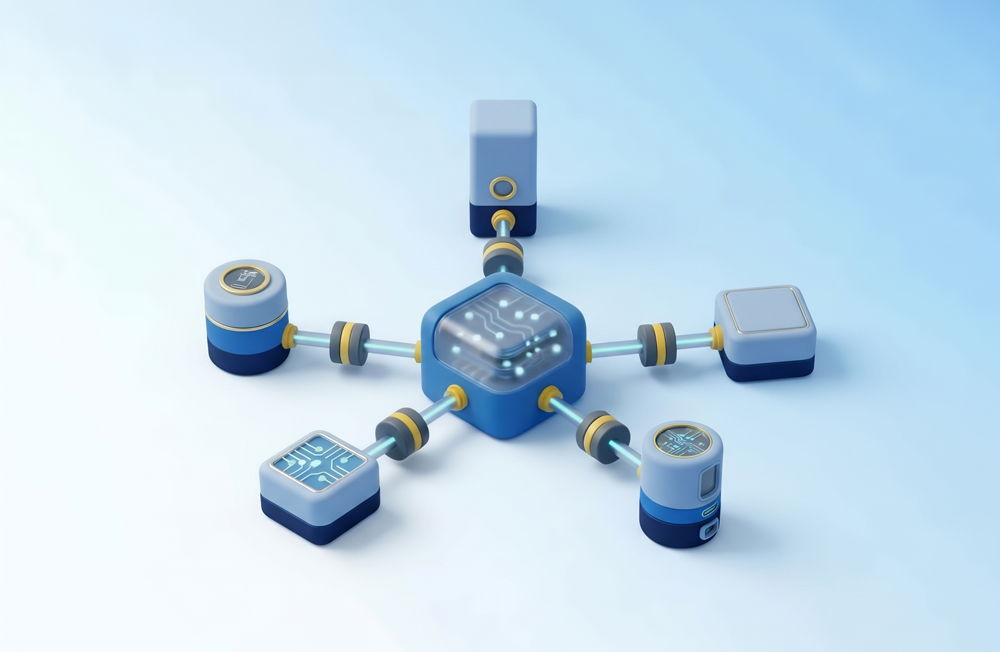
AI agent orchestration allows teams to split security work across multiple AI agents and agentic workflows, each with a narrow scope. For example, when an alert arrives, a coordinator agent can pass it to three specialists in turn. A triage agent sorts the alert, an enrichment agent gathers details on the hosts and accounts involved, and a containment agent recommends a response.
Each specialist handles one job with its own tools, and the coordinator keeps hold of the full investigation. Older setups relied on a single broad model to run the whole thing. More agents means more handoffs, and AI agent orchestration security keeps each in check.
Architects build orchestrated systems on five common patterns.
In all five, agents pass work to one another, so AI agent orchestration security starts with containing a single agent's mistake. Microsoft's complexity ladder for agent design lists a separate security boundary for each agent as a valid reason to use multiple agents. The sections below show how SOC teams hold that boundary when an agent gets something wrong.
Most AI agent orchestration security gaps stem from an overloaded agent, an ungoverned handoff, or an unclear blast radius. Each leaves a clear symptom, and the table below shows analysts what to look for.
OWASP maintains the vendor-neutral Top 10 for Agentic Applications, a list of the most serious agentic AI risks. Two of its entries line up with the table. Insecure inter-agent communication covers the ungoverned handoff, and cascading failures covers the unclear blast radius. Kiteworks goes further in its blast radius analysis, tracing how a gap in shared infrastructure reaches every agent built on it.
In its 2026 report, Salt Security surveyed more than 300 security leaders and found that 48.9% of organizations cannot monitor machine-to-machine agent traffic. Agent handoffs run over that traffic, so those teams have no view of what one agent tells another.
Suppose a SOC team runs two agents in sequence. The first, a triage agent, labels an alert as benign beaconing, meaning routine check-in traffic to a known content delivery network (CDN). It passes that verdict and a confidence score to a response agent, which closes the case and suppresses the correlation rule. If the verdict is wrong, the response agent acts on it anyway. It never sees the underlying logs, so it has no way to check.
An analyst who reopens the case later cannot tell which agent labeled the alert, which log fields it read, or when the response agent acted. Okta treats these handoffs as identity and access events, the same kind of event security teams already log and control for human users.
In AI agent orchestration security, architects answer each failure mode with its own control. For the overloaded agent, they narrow each agent to a single task, which leaves it far less room to invent facts.
For the ungoverned handoff, they log every exchange and require analyst approval before any agent acts on a live system. Because the blast radius is unclear, they scope each agent's data and tool access separately, so any gap in a shared layer remains with the agents that touch it.
Strike48 solved the problem by narrowing each agent's scope. As we explain in our analysis of AI hallucinations in cybersecurity, the team first tried fine-tuning, model swaps, and confidence scoring, and edge-case errors kept showing up.
Data access gets the same treatment. With Strike48's Flexible Data Foundation, SOC teams connect each agent to exactly the logs it needs. Analysts use federated search to query data where it already sits, across S3, Splunk, Elastic, and existing SIEMs, so every source stays available without having to decide what to keep at ingestion.
Strike48 packages its specialist agents into Pre-Built Agent Packages for alert assessment, root cause analysis, forensic collection, and SOC management. Each package mixes fixed steps that run the same way every time, such as evidence collection, with judgment steps where the agent makes a single call. Analysts approve every consequential action before it runs and audit the outcome afterward.
The tradeoff is upkeep. Engineers maintain more agent mandates and revise them whenever the SOC's tools or data change.
GraphRAG is a retrieval method in which an agent pulls answers from a network of confirmed facts and their links, rather than from loose documents. Strike48 pairs each agent with a persona and a knowledge graph. The persona sets the agent's role, and the graph defines the data it can pull.
Each graph has three layers.
In the context layer, architects map hosts to business units, accounts to privileges, and assets to control frameworks. They then give each agent the exact slice it needs. If an analyst asks about a server in the finance unit, the agent pulls that server, the accounts that can reach it, and the frameworks that cover it.
Without a graph, a model falls back on general training and can invent details wherever that training runs thin. With one, the agent works from links the team has already verified.
Architects revise the graph as the network shifts, for example, when IT moves a host to another business unit or an admin grants an account extra privileges. When they keep up with those changes, the agent's view stays accurate. When they miss one, the agent reports on a setup that no longer exists.
Strike48 adds a second limit at the tool layer. Engineers configure Model Context Protocol (MCP) connectors so each agent can call only what its job requires. Assessment agents, for example, deploy with no connection to an isolation API. Strike48 records every call in the agent's audit trail, along with the reasoning behind it, so reviewers can confirm the restriction was upheld.
Analysts sign off on any action that changes the environment, such as isolating an endpoint, locking an account, editing a firewall rule, or deploying a fix. Agents investigate alerts, connect related events, and write up findings without waiting, because that work leaves systems untouched. Placing gates this way balances two risks. Gate every step, and analysts spend their shift clicking through routine requests. Gate nothing, and an agent could quarantine a whole group of endpoints over one misread alert before anyone noticed.
An analyst approving a request needs to see what the agent found, its confidence score, the explanations it ruled out, and the history of the account or asset involved. Strike48 covers checkpoint design in more detail in its post, “Human-in-the-Loop Done Right.”
An audit trail records what an agent did and why, and the SOC team leans on it whenever an auditor or regulator asks about a decision. To answer fully, engineers set each agent to log five facts about every action.
Each agent writes its entry at the moment it acts and names both parties whenever it passes work on. Strike48 keeps this trail for every action, so when someone asks how an agent reached a decision, the SOC team has the answer on record.
With a basic API log, a reviewer confirms that an agent ran. With all five facts, the reviewer sees what it concluded and why.
Before rollout, security architects should test a vendor's AI agent orchestration security with three questions.
Strike48 covers all three for every Pre-Built Agent Package on our Security Solutions page.
With a traditional AI model, a human reads the output and decides what to do with it, so a person stands between an error and its consequence. An AI agent calls tools and acts in a live environment, so a wrong conclusion can play out on real systems. Snowflake's guide to AI agent security goes wider, mapping the attack surface across the reasoning layer, the tool and API execution layer, memory, and agent-to-agent messaging.
Responders first work out which agent acted, on what data, and which downstream agents used the result. With an operation-level audit record, they can answer that with a single query. Without that record, they piece the chain together from infrastructure logs that show activity but not who caused it. To contain the failure, they revoke the agent's access to tools via its MCP connectors, much as an analyst isolates a compromised host.
For a single agent, teams control prompt handling, tool permissions, and output validation. With an orchestrated system, they apply those controls to every agent. AI agent orchestration security also covers each handoff and shared base layer, because one agent's error can become the next one's starting point.
Usually not by much. The coordinator hands work to more agents, which adds some coordination, but independent specialists can run in parallel using the concurrent pattern above. The higher cost is engineering upkeep, covered in the design controls section.