


AI agent adoption in the SOC roughly doubled in five months. In May, 36% of security leaders had agents in production for at least one use case. In October, 74% do.
Autonomy hasn't kept pace. Among teams with agents in production, 47% still have a human execute or pre-approve agent actions. Only 30% let agents act with high or full autonomy.
That gap is the focus of The State of Agentic Security H2 2026: The Journey from Agent Adoption to Autonomy. We surveyed 534 security and IT leaders across the US, Canada and the UK about how far they trust AI agents in the SOC and what agents must prove before they act alone. Here's what we found.
In May, trust was the top barrier to adoption. Five months later, 82% of leaders still agree L1 work belongs to agents, and the share ready to fully automate it holds at 22%. Production use roughly doubled anyway: 49% of respondents now run agents across multiple use cases, and another 25% run them for one use case.
Teams didn't wait for full trust before they deployed. They kept a human close. We asked leaders to place their agents on a six-level autonomy scale, from L0 (agents recommend, humans act) to L5 (agents are self-directed with strategic oversight). Among teams with agents in production, 47% keep humans executing or pre-approving actions, 23% let agents act within defined boundaries and 30% allow high or full autonomy.

Supervision got agents into production. The question now is how much authority to give them.
The first production use case may be the hardest test of trust. Among teams at that stage, 42% say they don't trust agent outputs enough to let agents act alone. Among teams running agents across multiple use cases, that figure drops to 14%.
Concern about hallucination follows the same pattern. It falls from 51% of teams not yet in production to 42% at one use case and 27% at multiple use cases.

Autonomy moves the other way. 41% of multi-use-case teams grant agents high or full autonomy, compared with 8% of teams with a single use case.
Security leaders are often skeptical to try agents, and quick to expand once they see them work. The open question is what separates teams that stay at one use case from teams that expand.
When we asked which SOC task they would automate first, 45% chose alert triage (24%) or investigation and root cause analysis (21%). Only 6% chose playbook and response execution, even though the question asked respondents to assume the agent worked without hallucinations or out-of-scope responses.
Leaders want agents investigating before they let them respond. Triage and investigation are where an agent builds the track record that earns it more authority.
The top barriers have shifted from what the agent does to what it can see. Lack of trust in AI outputs was the #1 barrier to broader deployment in May. It now ranks fourth. Data infrastructure ranks first: 31% of leaders say they lack the infrastructure to support effective agents.

The concerns about letting an agent act point the same way. Regulatory and compliance risk tops the list (46%), followed by the agent acting on incomplete or incorrect data (41%).
Both findings point to the same need. Agents must see the same data and telemetry a human analyst sees, and every agent action must leave a record that teams can explain and defend.
Leaders are ready to delegate once agents meet their conditions. Only 3% say a human must always approve an agent's actions. The rest named what an agent must prove before it acts in production without a human approving it first:
85% selected a track record of accuracy, a full audit trail or both.

"We would need to see a proven track record if the AI platforms can perform automated tasks with accuracy and fully in relation to compliance standards." Security leader, 5,000 to 9,999 employees, healthcare
The CIO or CTO is the most frequently named approver for AI agents with authority to act in production (40%). Another 33% say approval comes from themselves or another security leader. Even among security leaders, 47.5% point to the CIO or CTO, and the share is the same at companies with 5,000+ employees.
The proof has to hold up as a business case as well as a technical one.
87% of respondents are changing their L1 function because of AI agents. The largest moves are hiring for new skills (49%) and retraining L1 analysts to supervise agents (42%). Another 37% are shifting L1s into investigation roles.
Both retraining and moving L1s into investigation outpace headcount cuts (20%). The pattern leans toward redeploying L1 analysts, not replacing them.

The pressure to give agents more authority is growing. 56% of respondents have confirmed (26%) or suspect (30%) AI-assisted attacks against their organization in the last 12 months.
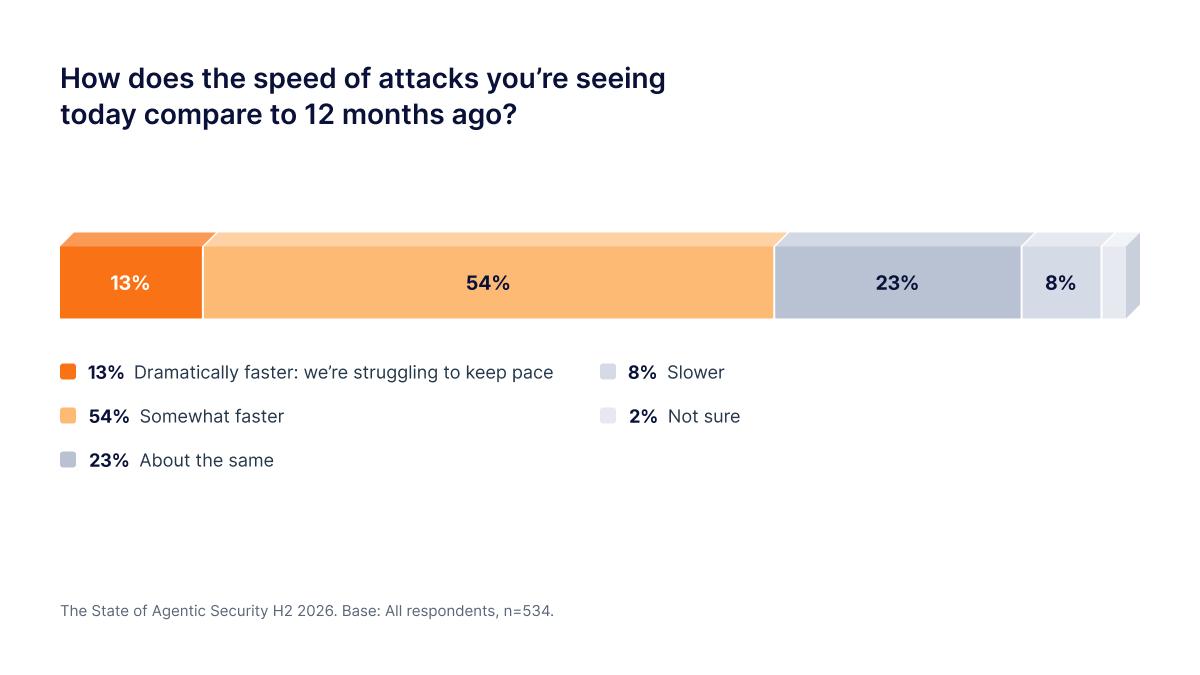
Attacks are also getting faster. 67% say attacks move faster than they did a year ago, including 13% who say attacks are dramatically faster and they're struggling to keep pace.
"At this point it may sound ridiculous but the highest priority is defending AI created attacks with AI." IT leader, 1,000 to 4,999 employees, IT services
When attacks move at machine speed, human-speed approvals become the bottleneck.
Leaders have made the decision to adopt AI agents. The open question is how much authority to give them. The data says that authority is earned in two places: the data layer, where agents need the same visibility a human analyst has, and the governance layer, where every action stays within enforced limits and leaves an audit trail.
Based on the survey data, here's a readiness checklist for teams moving from supervised agents to trusted autonomy:
Download The State of Agentic Security: The Journey from Agent Adoption to Autonomy for the full findings and charts.
See what 534 security and IT leaders need before they let AI agents act on their own. Get the full report with every chart and the full breakdown.
Strike48 surveyed 534 security and IT leaders at organizations with 200 or more employees and a security operations function. The survey was fielded September 29 to October 5, 2026, via Centiment, across the US (60%), Canada (20%) and the UK (20%). It follows Strike48's May 2026 survey of 100 security leaders. Percentages may not total 100% due to rounding.

Garrett Huddy is Director, Content Strategy at Strike48.