
Strike48 enables SOC teams to deploy a coordinated team of customized AI agents that triage alerts, investigate cases, threat hunt across your environment, and execute response actions. Every action is auditable, every decision is grounded in your data, and your team stays in control.
AI SOC agents are autonomous software agents that perform security operations center work (alert triage, threat investigation, threat hunting, and incident response) that has traditionally required human Tier-1 and Tier-2 analysts. Unlike a SOAR playbook or a chat-based security copilot, AI SOC agents reason over your security data, decide what to investigate, and take action within deterministic guardrails you define. They exist to solve the defining problems of the modern SOC: alert fatigue, analyst burnout, and slow mean time to respond (MTTR) driven by thousands of daily alerts from SIEM, EDR, and XDR tools.

the Alert lifecycle
Agents sit at the ingestion point, correlating and prioritizing real alerts so analysts never touch the noise.
Agents enrich indicators, gather evidence, map the attack chain, and build a complete case.
Threat-hunting agents run hypothesis-driven searches across your environment to surface what alerts miss.
Agents contain risk, communicate actions, and remediate, autonomously or via human approval on high-impact moves.
how it works
Strike48 takes a multi-agent approach. Instead of one monolithic model that hallucinates and loses context, specialized agents (an L1 triage agent, an L2 investigation agent, a forensic agent, and a threat-hunting agent) coordinate on a single shared case the way a real SOC team does.
Every decision is grounded in your environment through retrieval-augmented generation, every action is auditable, and high-impact responses route through human approval. The result is an autonomous SOC that scales analyst capacity without sacrificing control, transparency, or trust.

A single monolithic agent that tries to do everything will hallucinate, lose context, and produce unreliable results. Strike48 takes the opposite approach. Each agent has a narrow scope, defined tools, and bounded knowledge. The L1 Analyst Agent triages and correlates alerts. The L2 Analyst Agent investigates patterns and maps attack chains. The Forensic Agent collects evidence with chain of custody. The Threat Hunter Agent runs hypothesis-driven searches. Agents pass cases to each other with full context, just like a SOC team.
Black-box agents are not trustworthy agents. Strike48 shows its work. Every investigation includes the questions the agent asked, the data sources it queried, the evidence it gathered, and the reasoning that led to its verdict. Analysts review the trail in plain English. Auditors get a complete record. Compliance teams get the documentation they need without manual reconstruction.


You decide what each agent can do, what data it can access, and what actions require human approval. Run agents in observation mode while you build trust. Promote them to autonomous execution on specific alert types as accuracy meets your bar. Pull permissions back instantly if something feels off. The control surface is yours.
Strike48 agents access your knowledge bases, your runbooks, your case history, and your organizational context through retrieval-augmented generation. The L1 agent knows that the marketing team uses a third-party email tool. The L2 agent knows which assets are crown jewels and which are sandbox VMs. Investigations reflect your environment, not a textbook.


Pre-built security agents handle common SOC use cases on day one. When you need something specific (a fraud investigation agent, a compliance reporting agent, an integration that does not exist yet), Prospector Studio gives you a low-code environment to design, test, and deploy new agents. Describe the workflow in natural language. Define the tools. Set the guardrails. No dedicated AI team required.
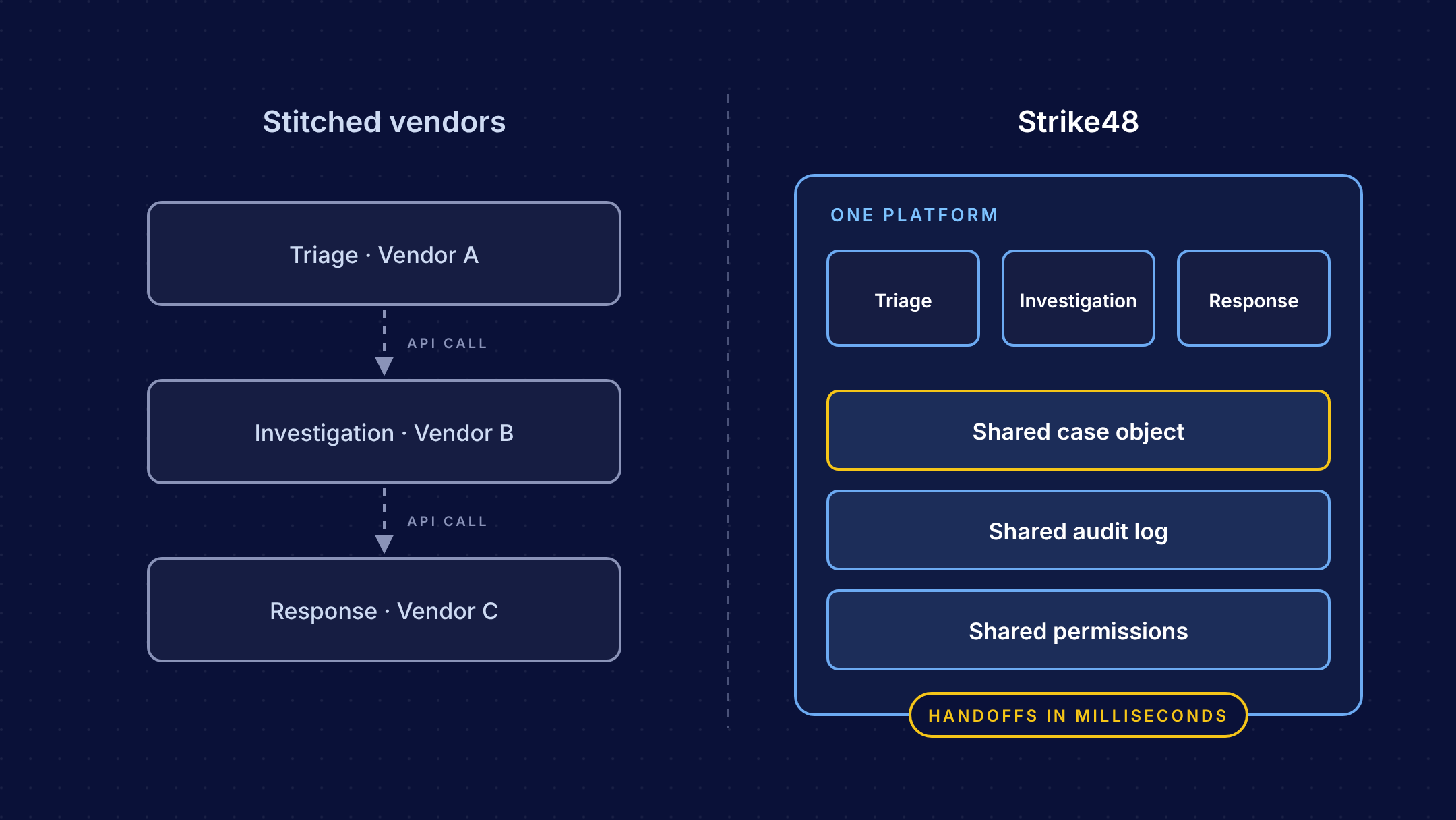
Stitching together a triage agent from one vendor, an investigation agent from another, and a response agent from a third creates a coordination problem worse than the one you started with. Strike48 agents share a single case object, a single audit log, and a single set of permissions. Handoffs happen in milliseconds, not API calls.
Example agent team
A coordinated team of customized agents covers every alert type, with human approval at every critical decision point.

Performs initial alert triage and investigation, determining whether alerts represent real threats or false positives before escalation.
Conducts deeper threat analysis by enriching alerts with additional context from threat intelligence, user behavior, and historical data.
Automatically categorizes and prioritizes incoming alerts based on severity, asset criticality, and threat context to focus analyst attention.
Analyzes emails and URLs for phishing indicators, flagging suspicious messages and automating initial investigation steps.
Continuously monitors threat intelligence feeds and security advisories to alert you about new vulnerabilities, exploits, and emerging threats.
Coordinates security operations across the team, managing workflows, prioritizing incidents, and ensuring timely response to security events.
Results from Strike48 customers in a 7-day period.
Get live demo walking through building agents and workflows for your unique SOC environment.